You Are Not Lazy. You Are Just in a Monsoon. (And Here's What to Do About It.)
Why grey skies flatten your mood, why pakodas aren't a character flaw, and how a sauna and an ice bath quietly fix it.
Let's talk about what actually happens to you in the monsoon. Not the postcard version (mist, chai, cosy blanket, soft rain on a tin roof). That part's real, and it's lovely. But there's another version too. The one where it's 11am and you genuinely cannot explain why you have zero motivation. Where you've been "meaning to do something" for three days running and somehow haven't moved an inch. Where you ordered the pakodas not because you were hungry but because your body insisted, loudly, in a tone that allowed no debate.
You are not lazy. You're not unmotivated either, whatever your inner critic has been muttering. You have a neurological condition that shows up every monsoon, hits most people around you too, and has an actual name. It's called SAD (Seasonal Affective Disorder), and while everyone associates it with grey winters in Scandinavia, it turns out Rishikesh's monsoon does the exact same number on your brain.
Reduced sunlight tanks your serotonin. Your brain reads the dimness as evidence something has gone wrong with the world, so it dials your energy down, flattens your mood, and (this part's almost funny once you know it) sends you into a fried-food spiral, because carbs nudge serotonin back up, briefly. The pakodas were never a character flaw. They're your brain attempting a chemical patch job with whatever's lying around.
Meanwhile, rain itself (technically pink noise, the same frequency as wind through leaves, oddly close to your own heartbeat) is built to make you drowsy. Your pineal gland, confused by the low light, starts pumping melatonin at the wrong hours. Your circadian rhythm, which runs entirely on sunlight cues, drifts off-script. By afternoon you feel like you've clocked more hours than you have. By evening you genuinely can't tell if you want to sleep or just sit there staring at the rain like it owes you an explanation. None of this is a personality problem. This is weather, doing things to your neurochemistry without asking permission. The only real question is what you do next.
The Wrong Answer (Which Most People Choose)
More chai. More pakodas. A third rewatch of something you've already seen twice. The vague plan to "do something tomorrow, once the rain stops." It won't stop. July in Rishikesh doesn't pause for your to-do list. We've checked, repeatedly, hopefully. We say this without judgment, because most of us have lived exactly this loop. There is, however, a specific, science-backed, slightly extreme, genuinely enjoyable way out of it.
The Right Answer: Get Into a Cedar Sauna, Then Get Into an Ice Bath
TAPAS, our Fire and Ice contrast therapy circuit, is, among other things, one of the more effective neurochemical interventions available on a grey monsoon morning. Here's what's actually happening in there.
The sauna heats your core to around 38 to 39°C, which triggers vasodilation. Blood vessels widen, circulation surges, and your body floods with heat shock proteins busy repairing cells and propping up your immune system. Muscles let go of tension they didn't admit to holding. Your nervous system, which has been running a low-grade stress response all morning courtesy of the weather and the general flatness, starts to stand down.
Then the ice bath. Cold immersion spikes norepinephrine, the chemical behind focus, alertness and mood, almost instantly. Research shows a deliberate cold plunge can lift dopamine by up to 250%, and unlike sugar, that lift doesn't crash. It holds for hours. No spike, no slump, just a steady, sustained climb in mood and clarity that follows you through the rest of your day.
There's also something called hormetic stress at play. By choosing discomfort on purpose, you train your nervous system out of catastrophising. The voice yelling "get out, this is too cold, I cannot do this" gets quieter, not just in the tub, but everywhere else too. Small frustrations stop registering as emergencies. Your 70,000-odd miles of blood vessels (yes, really, that's the body's full plumbing length) get a proper workout from the heat-cold alternation, contracting and expanding, flushing nutrients in and waste out. Most people walk away feeling a physical lightness that's hard to name and impossible to miss.
And then, the stone soak pool. Warm. Gentle. After the ice bath, frankly the kindest thing anyone's done for your body all week.
Why the Monsoon Makes This Even Better
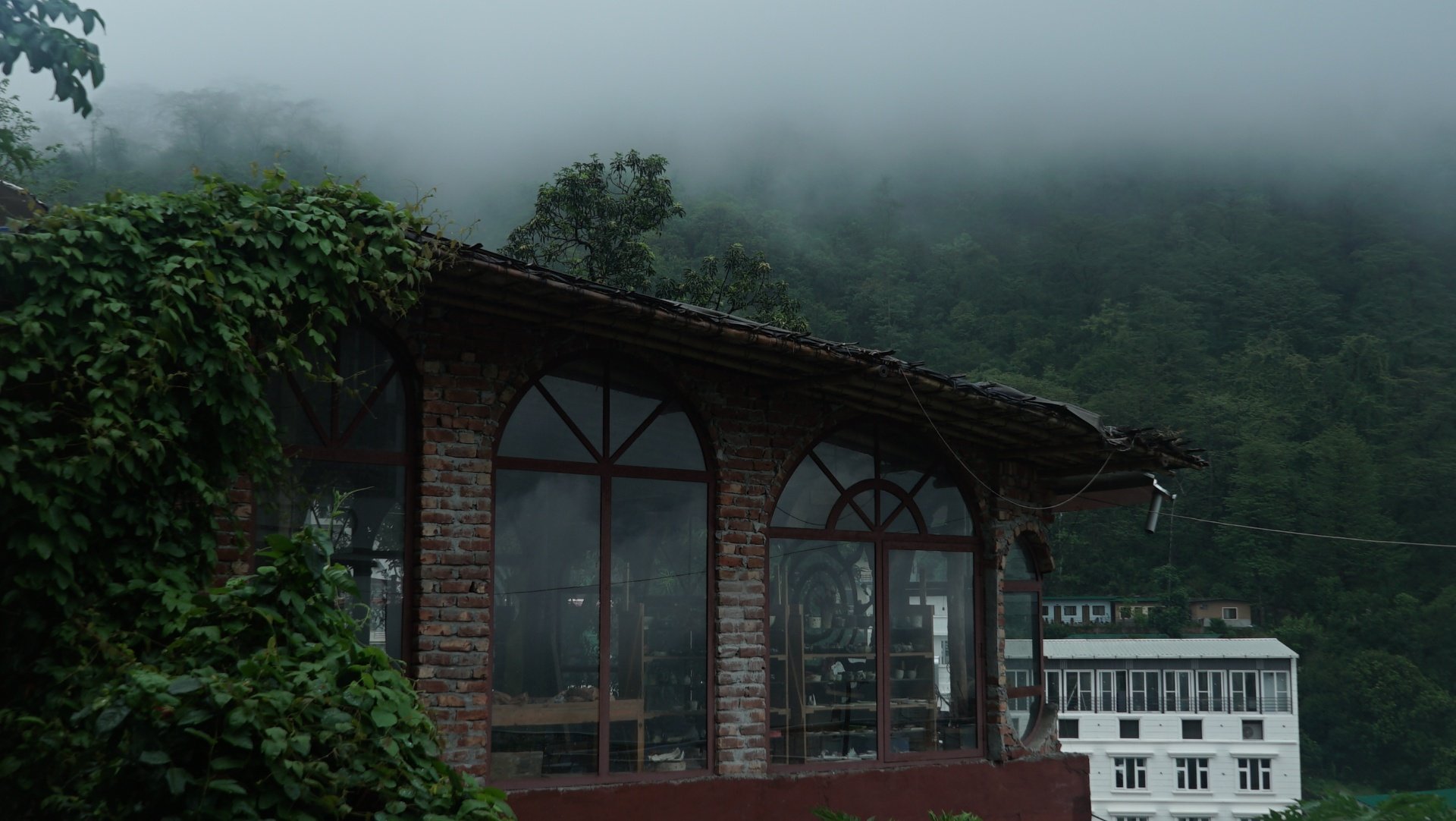
Here's something nobody mentions about contrast therapy specifically during monsoon: the weather amplifies all of it. You're sitting in a cedar sauna (wood walls, eucalyptus steam, heat that feels earned rather than switched on) while rain comes down across the Tapovan hills outside, the sound reaching you faintly through the cedar. Then you step into the ice bath, and now cold rain's falling on you too, mist sitting on the hills, and the line between "inside the spa" and "outside in the monsoon" just dissolves. No amount of clever architecture manufactures that.
This isn't a controlled wellness environment. It's a controlled wellness environment dropped inside a monsoon, inside the Himalayas, which is a very different thing. The contrast stops being merely physical and goes elemental. Fire inside, water outside, both chosen, both yours. The rain is happening to the whole valley regardless. You're just one of the few people not hiding from it.
The Pakoda Problem, Revisited
Back to the pakodas, briefly, because this matters. The monsoon craving for fried food is real. Your brain is self-medicating low serotonin with carbs. It works, sort of, for about twenty minutes. Then the dip arrives, heavier than before.
Cold exposure hits the same serotonin-dopamine shortfall through an entirely different door. Instead of importing a fix, you're triggering your body to manufacture its own, at levels food can't touch. Cold-plunge dopamine isn't sugar dopamine. It's cleaner, it lasts longer, and there's no comedown attached. We're not telling you to skip the pakodas. Ours are genuinely very good, ask anyone. We're saying: do TAPAS first, and the afternoon pakoda becomes a celebration instead of damage control. Small distinction. Makes a real difference.
What a TAPAS Morning Actually Feels Like
You arrive at 9am. Rain's already going, no surprises there. Into the cedar sauna (eucalyptus and wood hit you immediately) and you sit in dry heat for about twelve minutes while the valley quietly vanishes into mist outside. Your shoulders, which arrived somewhere up near your ears, start to drop. Breathing slows down on its own.
Then the ice bath, and this is where pleasant stops and interesting begins. The cold lands all at once. Every instinct says get out, now. Sadhu, our facilitator, has done this hundreds of times and has the genuinely irritating ability to make it look effortless. He talks you through your breath instead. You stay. Around the ninety-second mark, something shifts. Not comfortable, exactly. Manageable. And in that small act of staying put through discomfort, something in your nervous system quietly resets.
You climb out more awake than you've felt in days, mist sharper, rain louder, everything turned up a notch. The soak pool warms you back up slowly, and by the time you're toweled off, the flatness that arrived with the monsoon feels, at minimum, up for negotiation. That's forty-five minutes, one grey morning, one noticeably different person. Then, yes, pakodas.
Is This For You?
If your first reaction is "I would never get into an ice bath", that's nearly universal, and almost never the lasting one. Most people who do the circuit once come back for more. Not because cold water grows on them. Because they like who they are for the rest of that day.
TAPAS runs through the week, open to both guests and day visitors. Facilitators walk you through your first session, you set the pace, and the ice bath depth is adjustable. This isn't a machismo endurance test, it's a thoughtful neurological reset in one of the more beautiful settings you'll find for doing anything at all. Monsoon is roughly six weeks of grey skies, low light, and your own brain quietly working against you. You can wait it out with chai, pakodas, and reruns. Or you can just get in the sauna.
WhatsApp us or write to home@aavya-rise.com
The Aavya team · TAPAS at Aavya Creative Wellness Retreats · Upper Tapovan, Rishikesh
Related reading from the Journal
- Wellness & Recovery
Why heat? Inside the sauna at Aavya
There is a point in the sauna when the conversation thins out. Someone moves to a lower bench. Someone closes…
Read article → - Wellness & Recovery
Why cold? What to expect from an ice bath
Before a first ice bath, most people ask how long they should stay in. Once they enter, the question tends to…
Read article → - Wellness & Recovery
Why combine sauna and ice baths?
The sauna and the ice bath tend to attract different loyalties. Some people are quite happy on the warm bench…
Read article →